

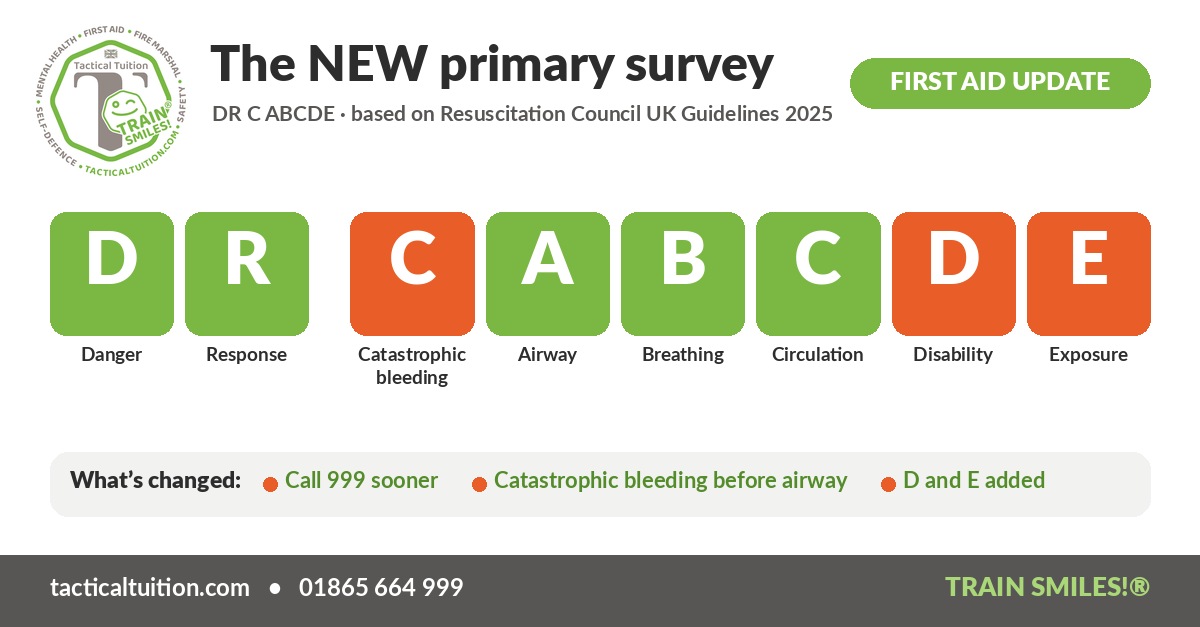
If your workplace First Aiders trained a few years ago, there’s a good chance they learned the primary survey as “DR ABC”. Today it’s taught as DR C ABCDE, and the reasons behind the change are worth knowing.
On 27 October 2025 the Resuscitation Council UK (RCUK) published its 2025 Resuscitation Guidelines, and for the first time they include a dedicated First Aid chapter. RCUK says the 2025 guidelines are being brought into courses from January 2026, so if you’re booking or refreshing training now, this is what your team should be learning.
Here’s what has changed, what DR C ABCDE means in practice, and what it means for you as an employer.
What changed in the 2025 guidelines?
RCUK updates its guidelines on a five-year cycle, and the 2025 edition replaces the 2021 guidelines. Three changes matter most for workplace First Aiders:
- First Aid now has its own chapter. RCUK calls it “a brand-new chapter”, recognising First Aid as the first link in the chain of survival.
- 999 comes earlier. If someone is unresponsive, RCUK now advises calling 999 before you assess their breathing, ideally with your phone on speaker so your hands are free and the call handler can talk you through what to do.
- A structured assessment. First Aiders should pay immediate attention to safety, the casualty’s responsiveness and any life-threatening bleeding, then use the ABCDE approach (Airway, Breathing, Circulation, Disability, Exposure).
The new primary survey: DR C ABCDE
RCUK sets out the priorities rather than a memory aid. Across UK First Aid training, those priorities are commonly taught as DR C ABCDE, and that’s how we teach it at Tactical Tuition. (You may also see it written DR<C>ABCDE or DRcABCDE. It’s the same sequence.)
- D – Danger: make sure it’s safe for you, any bystanders and the casualty before you go in.
- R – Response: introduce yourself and ask them a question. If they don’t respond, call 999 (or 112) straight away, phone on speaker, before you check their breathing.
- C – Catastrophic bleeding: control life-threatening bleeding now, before anything else. Apply firm, direct pressure to the wound. RCUK’s escalating approach then moves to a haemostatic dressing and/or a tourniquet, if you have one and are trained to use it.
- A – Airway: open the airway with a head tilt and chin lift.
- B – Breathing: look for normal breathing. If they’re unresponsive and not breathing normally, treat it as cardiac arrest: start CPR and get a defibrillator (AED) on the way. RCUK is clear that slow, laboured breathing or occasional gasps are signs of cardiac arrest, not normal breathing.
- C – Circulation: look for signs of shock and check for any other bleeding.
- D – Disability: check their level of response and look for signs of stroke or head injury. RCUK recommends a stroke tool such as FAST (Face, Arm, Speech, Time).
- E – Exposure: check for hidden injuries, then keep them warm. Cover them with dry blankets or clothing to reduce heat loss.
If someone is unresponsive but breathing normally and doesn’t need CPR, RCUK advises the recovery position, except where there is trauma or abnormal (agonal) breathing.
What’s actually different from DR ABC?
- The 999 call comes sooner: as soon as you find someone unresponsive, not after the breathing check.
- Catastrophic bleeding comes first: it is now dealt with before the airway, rather than later in the sequence.
- D and E complete the picture: Disability and Exposure help First Aiders spot strokes, head injuries and hidden injuries, and keep the casualty warm, all things that are easy to miss when the survey stops at C.
What this means for employers
Under the Health and Safety (First-Aid) Regulations 1981, employers are expected to carry out a First Aid needs assessment and make sure there are enough suitably trained First Aiders (or an appointed person). HSE says annual refresher training isn’t mandatory, but it is strongly recommended, to help First Aiders keep their skills sharp and stay up to date with changes in First Aid procedures. A guideline change like this one is exactly why.
A few practical steps:
- Check your records. When did each of your First Aiders last train? First Aid at Work and Emergency First Aid at Work certificates are valid for three years.
- Refresh anyone trained on the old sequence. A half-day Annual First Aid Refresher is a practical way to bring qualified First Aiders up to date with DR C ABCDE without waiting for requalification.
- Look at your First Aid kits. RCUK says every workplace should have a First Aid kit, stocked for your setting and the risks you face, and inspected and maintained regularly.
- Share the sequence. Put DR C ABCDE where your team will see it, so it’s fresh in their minds when it matters.
Training that comes to you
Most of our training happens in-house, at your workplace or a location of your choice, with up to 12 delegates per course. Our First Aid at Work, Emergency First Aid at Work and Annual Refresher courses are Ofqual-regulated, taught by experienced trainers with clean DBS checks, and built around hands-on, real-world scenarios. And because we TRAIN SMILES!®, your team will enjoy it too.
Not sure what cover you need? Book a FREE First Aid Health Check. We’ll come to your workplace, school or group, look at how many people you have on site and the different areas of your premises, and send you a report with our recommendations.
Frequently asked questions
Do my First Aiders need to requalify because of the 2025 guidelines?
Their certificates remain valid until they expire (three years for First Aid at Work and Emergency First Aid at Work). But HSE strongly recommends annual refresher training to keep First Aiders up to date with changes in procedures, and a refresher is the quickest way to bring them up to speed with DR C ABCDE.
Why call 999 before checking breathing?
Recognising cardiac arrest can be difficult, especially under pressure. RCUK’s 2025 guidance advises calling 999 for anyone who is unresponsive, before you assess their breathing. With the phone on speaker, the call handler can help you decide whether it’s a cardiac arrest and guide you through CPR.
What counts as catastrophic bleeding?
Bleeding that is life-threatening, for example heavy bleeding from a serious wound that won’t stop. RCUK asks First Aiders to deal with it straight away: firm, direct pressure first, then a haemostatic dressing and/or a tourniquet if you have one and are trained to use it, and call 999.
Is your team’s First Aid training up to date?
We deliver First Aid at Work, Emergency First Aid at Work and Annual First Aid Refresher courses in-house, at your workplace, for up to 12 delegates. All updated for the RCUK 2025 guidelines and DR C ABCDE. We TRAIN SMILES!®
Not sure what cover you need? Book your FREE First Aid Health Check and we’ll come to you.
Phone: 01865 664 999
Book your FREE First Aid Health Check Enquire about in-house training